Hreflang canonical map: the canonical hreflang set for every page in every locale, and what each version has to name
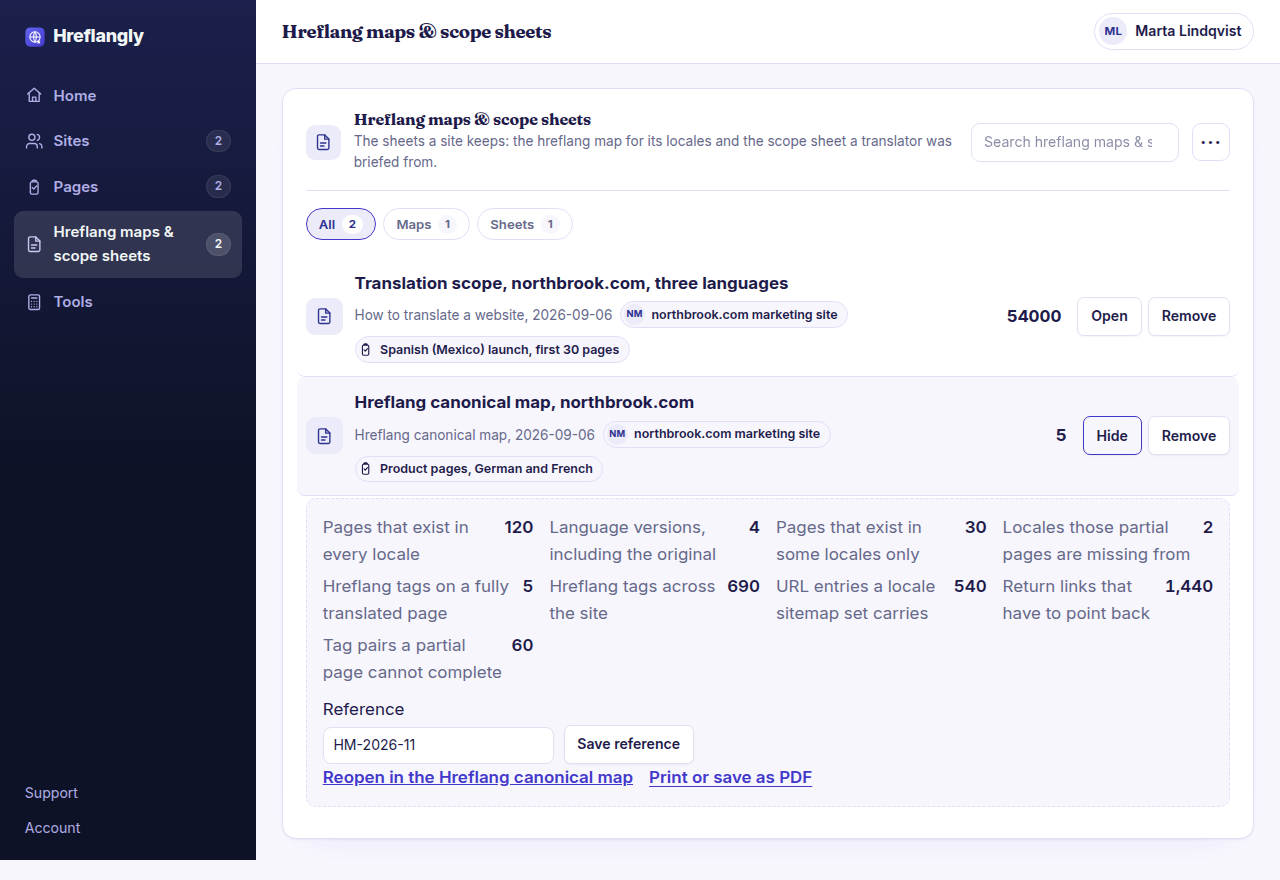
- Hreflang tags on a fully translated page
- 5
- Computed on this page from the inputs below
- Hreflang tags across the site
- 690
- Computed on this page from the inputs below
- URL entries a locale sitemap set carries
- 540
- Computed on this page from the inputs below
- Return links that have to point back
- 1,440
- Computed on this page from the inputs below
The arithmetic runs on the figures you type. The tag rules the map applies are Google's own documented requirements for localized versions, linked where they are used.
Email me this result
We will send you these figures and a link back to them. One email, nothing else unless you tick the box.
The figures are a worked example from one site, 5, so put your own pages and locales in and the answer changes on the page.
Download the Hreflang canonical map worked example (CSV)
An hreflang map is the set of tags that tells a search engine which language version of a page to serve to which reader. Google's own guidance is that each language version must list itself as well as all the others, and that if page X links to page Y then Y has to link back, or the annotations may be ignored entirely. That turns into a surprising number of links on a real site: this worksheet counts them from your own page and locale figures, including the pages that exist in only some languages and therefore cannot complete their pairs.
Where the constants in this tool come from
Google Search Central, tell Google about localized versions of your page.
Google Search Central, managing multi-regional and multilingual sites.
What a site owner asks before running the Hreflang canonical map
How many hreflang tags does one page need?
One for every language version including itself, plus an x-default if you have a page for unmatched languages. On a four-locale site that is five tags on every page.
What happens if a page only exists in two of our four languages?
It carries tags for the versions that exist and cannot complete the pairs for the ones that do not. The worksheet counts those as missing pairs so you can see how much of the map is waiting on translation.
Do the tags go in the head, the sitemap or the headers?
Any of the three, and you pick one. The counts are the same either way; the sitemap route is usually easier on a large site because it is one file rather than an edit on every page.
Should a translated page canonicalise to the original, and what breaks if it does?
No. The canonical says which URL to index among duplicates; the hreflang says which language version to serve to which reader. A German page is an alternate of the English one, not a duplicate, so it carries its own self-referencing canonical. A German page canonicalised to the English one with hreflang naming both contradicts itself, the canonical usually wins, and the German page disappears from results while every tag on the site looks present.
What is a self referencing hreflang, and what happens if it is missing?
A tag on a page naming that same page as a language version. Google's guidance is that each version must list itself as well as all the others; leave it out and the set is incomplete, the same as a missing return link, and the annotations may be ignored. It shows up as the wrong language version ranking in a market rather than as an error anywhere, and it is the commonest omission on a set built by hand.
How do I check canonical and hreflang together on a page?
Open any translated page and read three things: does the canonical point at itself, does the hreflang set include itself, and does every URL in that set point back with the same set. True on a sample across templates, the site is almost certainly fine. The map on this site says how many sets there are to sample from.